Weighted Blankets and Insomnia: One Strong Trial, and What It Doesn't Show
In a 120-patient trial, a weighted blanket halved insomnia scores for 6 in 10 people. Pooled evidence is thinner. What to expect, and who should skip one.
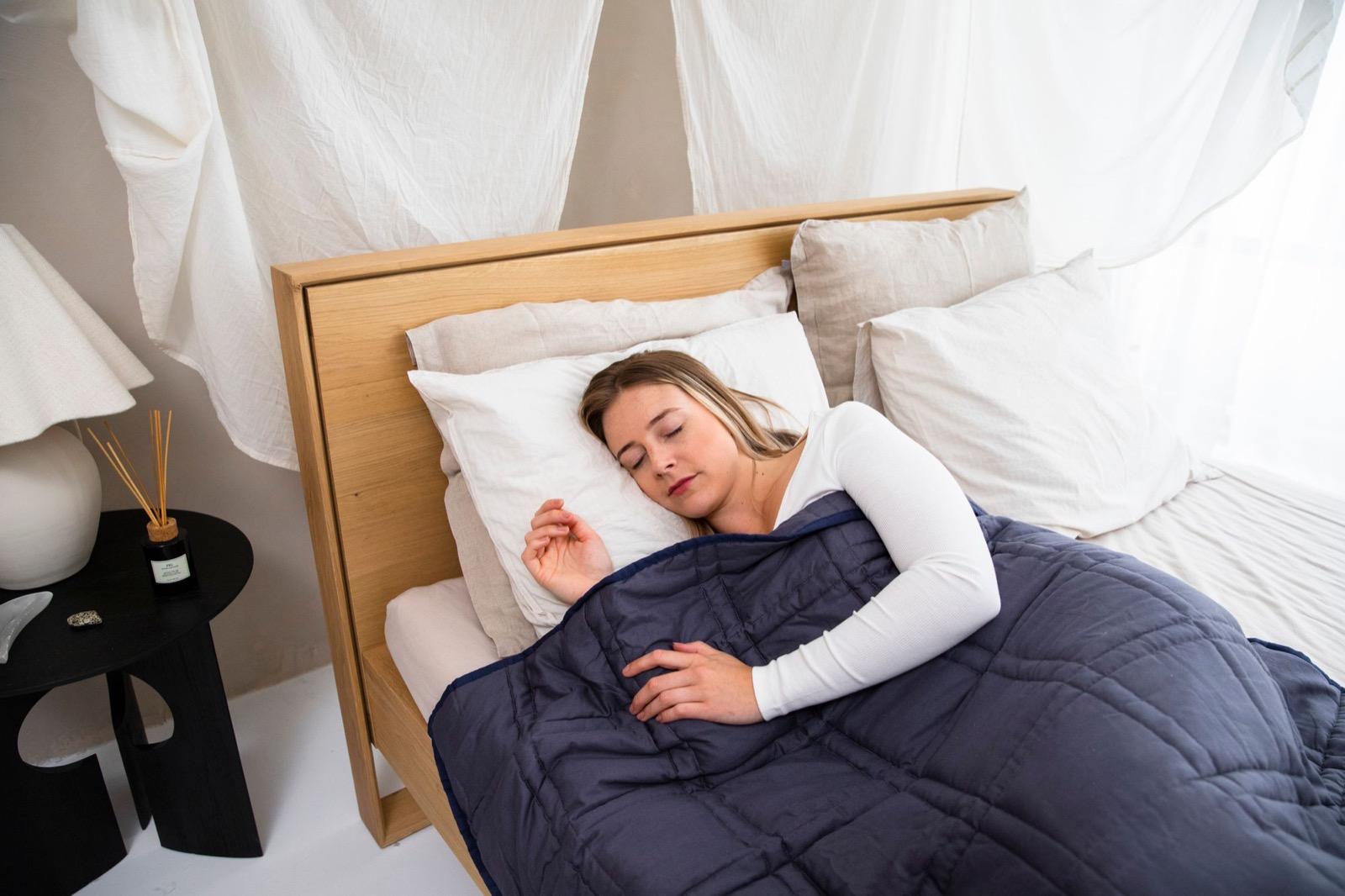
A weighted blanket has glass beads or metal chains sewn in, and the claim is that lying under it helps you sleep. One good trial supports it; a pooled analysis could not confirm it. Both are worth reading before you spend the money.
The numbers
Nearly one adult in five has trouble staying asleep. In the CDC's 2024 National Health Interview Survey, 18.1% of US adults said they had trouble staying asleep most days or every day: 21.4% of women and 14.6% of men.
6 in 10 responded, against 1 in 20. In the 2020 Karolinska trial of 120 psychiatric patients with insomnia, 59.4% of those given a weighted blanket for four weeks cut their insomnia score by at least half. In the light-blanket group it was 5.4%.
The pooled result is not significant. A 2024 meta-analysis in Complementary Therapies in Medicine found eight randomized trials, 426 patients in all. Only three reported an insomnia score that could be pooled, and the pooled difference (1.92 points on a 28-point scale) did not reach statistical significance.
A 32% bigger pre-sleep rise in melatonin, in 26 healthy adults. That was the only hormonal difference in an Uppsala laboratory study published in 2023, comparing a weighted and a light blanket. Sleepiness and sleep length did not differ.
Half of the trials have a blinding problem. The 2024 review rated four of its eight trials at high risk of bias, mostly because people can feel which blanket they are under.
Why pressure might help
Occupational therapists in psychiatric care use weight and compression to calm patients, and the Karolinska authors describe the proposed mechanism as deep pressure stimulation: steady pressure across the body, thought to shift the nervous system toward its rest-and-digest side.
The Uppsala experiment is the first direct test of a hormonal pathway: twenty-six healthy adults, average age 24, spent one night under a blanket weighing about 12% of their body weight and another under one weighing about 2.4%. Under the heavy blanket, saliva melatonin rose about 32% more in the hour before lights-out. Cortisol, alpha-amylase (a marker of sympathetic nerve activity), oxytocin, sleepiness and sleep length did not differ between the blankets. The authors say they cannot tell whether that extra melatonin matters for sleep. The blankets were provided by a Swedish weighted-blanket company, and one of the twelve authors is its employee.
The trial worth knowing
The Karolinska study was published in 2020 in the Journal of Clinical Sleep Medicine, funded by the Stockholm regional health authority, and the authors declared no conflicts of interest.
It enrolled 120 adults from psychiatric outpatient clinics in Stockholm. All had clinical insomnia for more than two months plus one of four diagnoses: major depression, bipolar disorder, generalized anxiety disorder or ADHD. Their sleep problems had lasted an average of 20 years, and most were on medication.
Sixty-four were given a chain blanket weighing 8 kg, about 17.6 lb, with a 6 kg (13.2 lb) option for anyone who found that too heavy; ten people took it. The other 56 got a blanket of the same size and shape with plastic chains, weighing 1.5 kg, about the weight of an ordinary comforter. Patients were told only that there were two types of chain blanket; the rater did not know who had which, with one accidental exception. One patient stopped because the blanket made them anxious. Nobody else reported a side effect.
After four weeks, the average insomnia score in the weighted group had fallen from 21.7, near the "severe" line, to 9.2, which the scale calls subthreshold. The control group went from 21.2 to 18.8. The 59.4% response rate against 5.4% works out to odds of responding about 26 times higher. Remission, a score of 7 or less, was reached by 42.2% against 3.6%. Fatigue, depression and anxiety scores improved too.
What the trial doesn't show
The main result is a questionnaire. The trial also put wrist monitors on the patients; usable before-and-after recordings came from 77 of the 120. Those recorded no significant change in total sleep time, and no significant change in time awake after falling asleep, for the weighted group as a whole. Only the responders showed less wake time on the monitor.
The patients were not typical poor sleepers. Everyone had a psychiatric diagnosis alongside their insomnia, and most were on medication. None of the reviews here found an insomnia trial of this size in people whose only complaint is bad sleep.
The 12-month follow-up had no control group. After the four weeks, 112 of the 119 completers chose to keep a weighted blanket, and the control patients switched to one. At 12 months, on the same questionnaire, 92% of the 119 counted as responders and 78% as in remission. With everyone on a weighted blanket and nothing to compare against, that shows the effect lasted, not that the blanket caused it.
What the reviews say
Two systematic reviews come out more cautious than the single trial.
A 2020 review in the American Journal of Occupational Therapy found only eight studies of any design, did not pool them, and concluded that weighted blankets "may be an appropriate therapeutic tool in reducing anxiety; however, there is not enough evidence to suggest they are helpful with insomnia." It was written before the Karolinska trial was published.
The 2024 meta-analysis came after it. Its authors, in Zhengzhou, China, found eight randomized trials in people with mental disorders, 426 patients between them. Pooling five trials, they found a small reduction in anxiety. Pooling the three whose insomnia scores could be combined, they found a difference of 1.92 points that just missed statistical significance. Dropping the one trial that did not fit the others left two, with a significant 2.78-point difference. No serious adverse events were reported in any trial. Their conclusion: weighted blankets "may be a safe and effective add-on treatment" for psychiatric patients, but the results "need to be further confirmed" because the studies are few, small and different from one another.
There is also a Swedish register study of 1,785 adults with psychiatric diagnoses who were prescribed a weighted blanket. In the year that began six months after the prescription, the share with no sleep-medication prescription was 3.3 percentage points higher than the year before: a small shift, in a before-and-after study with no comparison group of people who got no blanket.
Put together: one well-run trial with a large effect on how people rate their sleep, in a specific patient group; a pooled estimate in the same direction but not statistically secure; and no insomnia trial yet in people without a psychiatric diagnosis.
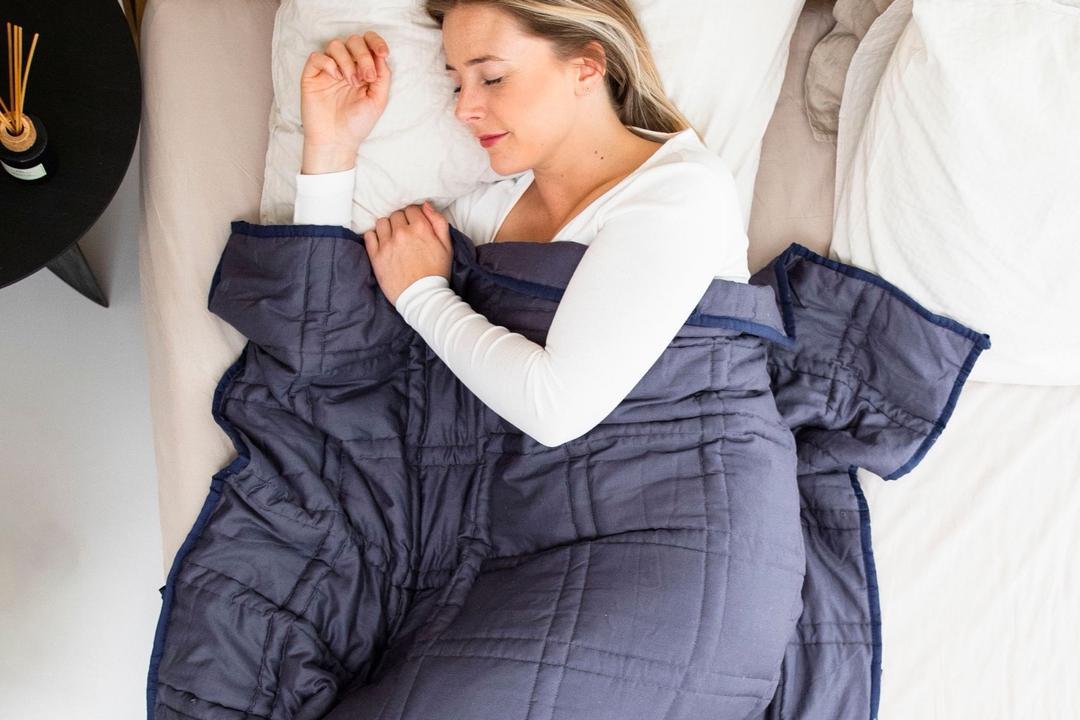
What can help: a weighted blanket is in our range, and the evidence above is the honest case for it. The trial that supports it used 13 to 18 lb blankets on adults with insomnia and a psychiatric diagnosis, and measured how they rated their sleep. If you have trouble staying asleep and have ruled out the usual causes, it is a reasonable four-week experiment. Choose about 10% of your body weight, and skip it for children under 3 or for anyone who cannot push it off on their own.
Who should not use one
Infants, without exception. The American Academy of Pediatrics' safe-sleep guidance says, "Don't use weighted blankets, sleepers, swaddles" or other weighted objects on or near a baby. The house rule here is wider: not for children under 3, and not for anyone, at any age, who cannot remove the blanket unaided.
Beyond that, none of the studies here was designed to test safety in people with breathing, circulation or mobility problems. If that is you, ask a doctor before trying one. And if the weight makes you anxious rather than calm, as it did for one trial patient, stop.
How to try it fairly
- Pick a blanket close to 10% of your body weight. The trial offered a lighter option, and one in six took it.
- Use it every night for four weeks. In the trial the effect was already visible at week one.
- Rate what the trial rated: time to fall asleep, night wakings, and how you feel the next day. Write it down before you start.
- If nothing has changed after a month, stop. In the trial, the weighted group's score was most of the way to its final value by week two.
This article is general information, not medical advice. The trial described here was in patients under psychiatric care, with treatment supervised by clinicians. If you have had insomnia for more than a few weeks, see a doctor; a blanket is an addition to that conversation, not a substitute for it.
Products mentioned
Keep reading
- The Nightcap Problem: Two or Three Drinks Are Enough to Cut Into Your REM SleepNearly one in five US adults uses alcohol to sleep. A 2025 meta-analysis of 27 studies found REM sleep delayed and cut from about two to three drinks.7 min read
- Melatonin, Magnesium, Weighted Blankets and the Wind-Down Ritual: What the Evidence Actually SaysAn honest look at the trials behind the most popular sleep aids—melatonin, magnesium, weighted blankets, lavender and tea—plus how to build a routine that makes them work.6 min read
- Nearly 1 in 3 American Adults Is Short on Sleep. Here's What the Numbers Say—and What Actually HelpsCDC, AASM, RAND and NHTSA data on how much Americans sleep, what it costs, and the five levers that research says move the needle.5 min read
Sources
- Ekholm B, Spulber S, Adler M (2020). A randomized controlled study of weighted chain blankets for insomnia in psychiatric disorders. Journal of Clinical Sleep Medicine, 16(9):1567-1577 — https://pubmed.ncbi.nlm.nih.gov/32536366/
- Zhao Y, Zhang Q, Liu Z, Zhao Z, Zhu Q (2024). Safety and effectiveness of weighted blankets for symptom management in patients with mental disorders: a systematic review and meta-analysis of randomized controlled trials. Complementary Therapies in Medicine, 87:103104 — https://pubmed.ncbi.nlm.nih.gov/39447684/
- Eron K, Kohnert L, Watters A, Logan C, Weisner-Rose M, Mehler PS (2020). Weighted blanket use: a systematic review. American Journal of Occupational Therapy, 74(2):7402205010p1-p14 — https://pubmed.ncbi.nlm.nih.gov/32204779/
- Meth EMS, Brandão LEM, van Egmond LT, et al. (2023). A weighted blanket increases pre-sleep salivary concentrations of melatonin in young, healthy adults. Journal of Sleep Research, 32(2):e13743 — https://pubmed.ncbi.nlm.nih.gov/36184925/
- Steingrímsson S, Odéus E, Cederlund M, et al. (2022). Weighted blanket and sleep medication use among adults with psychiatric diagnosis: a population-based register study. Nordic Journal of Psychiatry, 76(1):29-36 — https://pubmed.ncbi.nlm.nih.gov/34106812/
- CDC/NCHS Data Brief No. 559 (April 2026). Short Sleep Duration and Sleep Difficulties Among Adults: United States, 2024 — https://www.cdc.gov/nchs/products/databriefs/db559.htm
- American Academy of Pediatrics, HealthyChildren.org. How to Keep Your Sleeping Baby Safe: AAP Policy Explained (safe-sleep guide) — https://www.healthychildren.org/English/ages-stages/baby/sleep/Pages/a-parents-guide-to-safe-sleep.aspx