A Warm Bath an Hour or Two Before Bed Can Help You Fall Asleep Faster
Ten minutes in warm water one to three hours before bed is linked to falling asleep several minutes sooner. The evidence is modest. How to try it safely.
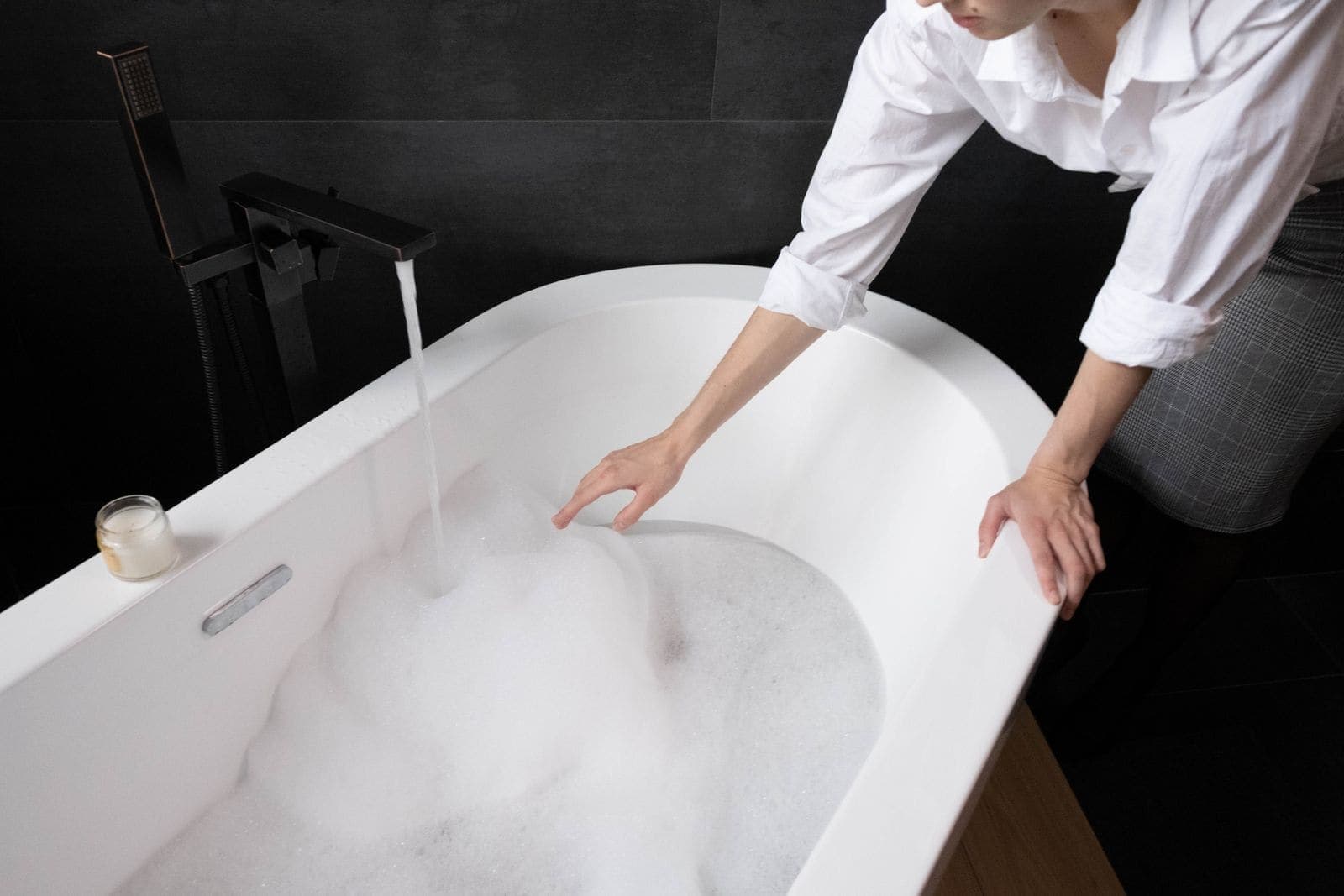
Here is an odd piece of sleep advice: if you want your body to cool down for the night, heat it up first.
It sounds backwards. It also has a meta-analysis behind it, which is more than most bedtime rituals can say, and it costs ten minutes and some hot water. The effect is a matter of minutes. I'll get to how many.
The numbers
More than one adult in seven struggles to fall asleep. In the CDC's 2024 National Health Interview Survey, 15.4% of US adults said they had trouble falling asleep most days or every day: 18.5% of women and 12.2% of men.
The main review found 5,322 candidate papers and pooled 13. It was published in Sleep Medicine Reviews in 2019 and linked water at 104 to 108.5°F to better sleep.
Ten minutes faster, by one count. That is the average the University of Texas gave in 2019 when it summarized its researchers' review.
Six minutes faster, by another. That was the largest difference in a 2021 study of 1,094 Japanese adults aged 60 and over.
104°F is the official ceiling. The US Consumer Product Safety Commission set it for hot tubs in a 1979 warning, and it matters here.
Why heating up might cool you down
The useful part of a warm bath seems to come after you get out.
The explanation favored by researchers at the University of Texas, whose review comes up below, runs like this. Warm water increases blood flow to the palms and the soles of the feet. That helps the body get rid of heat, and core temperature falls further than it otherwise would.
Older lab work points the same way. In a Swiss laboratory study from 2000, the best single predictor of how quickly volunteers fell asleep was the temperature difference between their hands and feet and the rest of their skin, a marker of heat leaving through the extremities. It beat core body temperature, heart rate, melatonin timing and how sleepy they said they felt.
What the review found
In 2019, a team led from UT Austin's biomedical engineering department searched the literature for studies of a warm shower or bath before bed. They started with 5,322 candidate papers. Seventeen met their criteria, and 13 had numbers comparable enough to pool.
Water at 40 to 42.5°C, which is 104 to 108.5°F, was associated with better self-rated sleep quality and better sleep efficiency. Scheduled one to two hours before bedtime, for as little as 10 minutes, it also significantly shortened the time it took to fall asleep.
How much shorter? The paper's abstract gives no figure. The university's own summary of the work puts it at an average of 10 minutes and names about 90 minutes before bed as the best timing.
How far to trust it
Less far than the headlines did.
The review's authors say themselves that the research is scarce, especially on the best timing and duration. A later paper is more specific. A team at Nara Medical University in Japan, summarizing the review in their own study, noted that it pooled 294 participants, and that the one-to-two-hour timing result came from just two studies: 23 patients with vascular dementia and 13 with traumatic brain injury, each heated for a fixed 30 minutes. That is thin ground for advice to healthy adults.
So the Japanese team went and measured it in ordinary life. They monitored their 1,094 volunteers at home for two days, recording baths, sleep (by wrist monitor and by self-report) and, in 569 of them, skin temperature. Baths taken one to three hours before bed went with falling asleep sooner than no bath. The 6-minute difference, the largest they saw, showed up on both measures, for baths of at least ten minutes taken two to three hours before bed. In the people wearing temperature sensors, wrists and ankles also ran about half a degree Celsius warmer relative to the abdomen during the first half hour in bed.
Six minutes, in older Japanese adults, in the colder months, from a study that only observed what people did. It can't prove the bath caused the faster sleep.
Put together: the direction is consistent, the mechanism is plausible, and the size is a handful of minutes. If you lie awake for forty, getting six to ten of them back is still worth a bath.
One more gap. The review was framed around showers and baths alike, but the Japanese study excluded people who only showered. A warm shower is a reasonable stand-in. It is also the one the Japanese study did not test.
How to do it
- Finish one to three hours before you go to bed. For an 11 p.m. bedtime, be out of the water by 9:30.
- Keep the water at about 104°F (40°C). That is the bottom of the range the review linked to better sleep, and the safety section below explains why not to go hotter.
- Stay in for ten to fifteen minutes. Ten was enough in the review, and the same Japanese team's earlier report put the average home bath at 13.3 minutes of heating.
- Then let yourself cool. If the heat-loss explanation is right, the drop afterwards is the point, so don't bundle up straight away.
What can help: if the heat-loss explanation is right, the bath starts the cooling and the bed has to let it continue.
- A water-cooled mattress pad is the closest thing in our range to anything that has been tested. In a small 2018 lab trial, 15 healthy young men slept on a mattress built to draw away more body heat: compared with a conventional mattress, their core temperature fell further and they got 16% more deep sleep. That was a mattress, in young men, and it measured deep sleep rather than how fast they fell asleep, so read it as a pointer.
- A cooling pillowcase, a cooling duvet cover or a temperature-regulating pillow. None of these was tested in the bath studies or in that trial. They are a comfort choice that fits the mechanism.
The usual mistakes
Timing is the big one. A shower in the last few minutes before you lie down isn't what any of this evidence supports. By the proposed mechanism, you'd be getting into bed before the cooling has happened.
Expecting too much is the other. The clearest result is on falling asleep. The review's abstract reports nothing on waking at 4 a.m., and the numbers on offer are minutes.
Don't make it hotter
This is the part to read before running the tap.
The upper end of the review's range, 108.5°F, is above what US safety officials consider acceptable for soaking. In its 1979 warning about hot tubs, the Consumer Product Safety Commission said water should never exceed 104°F and called 100°F safe for a healthy adult. It also said that soaking at 106°F can raise body temperature to the point of heat stroke, and that this can be fatal even to fully healthy adults.
That warning was written for hot tubs, not a ten-minute bath. It is still a good reason to stay at 104°F and no higher.
The same release lists who needs more caution than that:
- Pregnant women. Water above 102°F in the first three months can harm the fetus, and the CPSC's advice is to stay at 100°F or below.
- People with heart disease, circulation problems, diabetes or blood pressure problems, who are told to get their physician's advice first.
- Anyone taking medication that causes drowsiness, who is told not to use hot tubs at all.
- Young children, for whom it urges special caution.
It also warns against drinking in hot water, because drowsiness there can lead to drowning. If any of this describes you, a shower at or below 100°F is the sensible version, even though it is cooler than the range the review linked to better sleep.
Try it this week
Pick three nights. Be out of the bath by 9:30 for an 11 o'clock bedtime, ten minutes at about 104°F, then keep the bedroom cool. If you're asleep sooner on those nights than on the others, you have your answer.
This article is general information, not medical advice. If you have trouble falling asleep most nights for more than a few weeks, see a doctor. A bath is not a substitute for that conversation.
Products mentioned
Active cooling and heating for your side of the bed, 55–115 °F.
Cool-to-the-touch fiber that pulls heat away from your face.
Breathable eucalyptus-blend cover for hot sleepers. Queen and King.
Phase-change gel layer that absorbs heat as you sleep.
Sources
- Haghayegh S, Khoshnevis S, Smolensky MH, Diller KR, Castriotta RJ (2019). Before-bedtime passive body heating by warm shower or bath to improve sleep: a systematic review and meta-analysis. Sleep Medicine Reviews, 46:124-135 — https://pubmed.ncbi.nlm.nih.gov/31102877/
- Tai Y, Obayashi K, Yamagami Y, et al. (2021). Hot-water bathing before bedtime and shorter sleep onset latency are accompanied by a higher distal-proximal skin temperature gradient in older adults. Journal of Clinical Sleep Medicine, 17(6):1257-1266 — https://pubmed.ncbi.nlm.nih.gov/33645499/
- Krauchi K, Cajochen C, Werth E, Wirz-Justice A (2000). Functional link between distal vasodilation and sleep-onset latency? American Journal of Physiology: Regulatory, Integrative and Comparative Physiology, 278(3):R741-R748 — https://pubmed.ncbi.nlm.nih.gov/10712296/
- University of Texas at Austin, Cockrell School of Engineering (18 Jul 2019). Take a Warm Bath 1-2 Hours Before Bedtime to Get Better Sleep, Researchers Find — https://cockrell.utexas.edu/news/take-a-warm-bath-1-2-hours-before-bedtime-to-get-better-sleep-researchers-find/
- CDC/NCHS Data Brief No. 559 (April 2026). Short Sleep Duration and Sleep Difficulties Among Adults: United States, 2024 — https://www.cdc.gov/nchs/products/databriefs/db559.htm
- U.S. Consumer Product Safety Commission (31 Dec 1979). CPSC Warns Of Hot Tub Temperatures, release 79-071 — https://www.cpsc.gov/Newsroom/News-Releases/1980/CPSC-Warns-Of-Hot-Tub-Temperatures
- Krauchi K, Fattori E, Giordano A, et al. (2018). Sleep on a high heat capacity mattress increases conductive body heat loss and slow wave sleep. Physiology & Behavior, 185:23-30 — https://pubmed.ncbi.nlm.nih.gov/29247670/